
living half unpacked
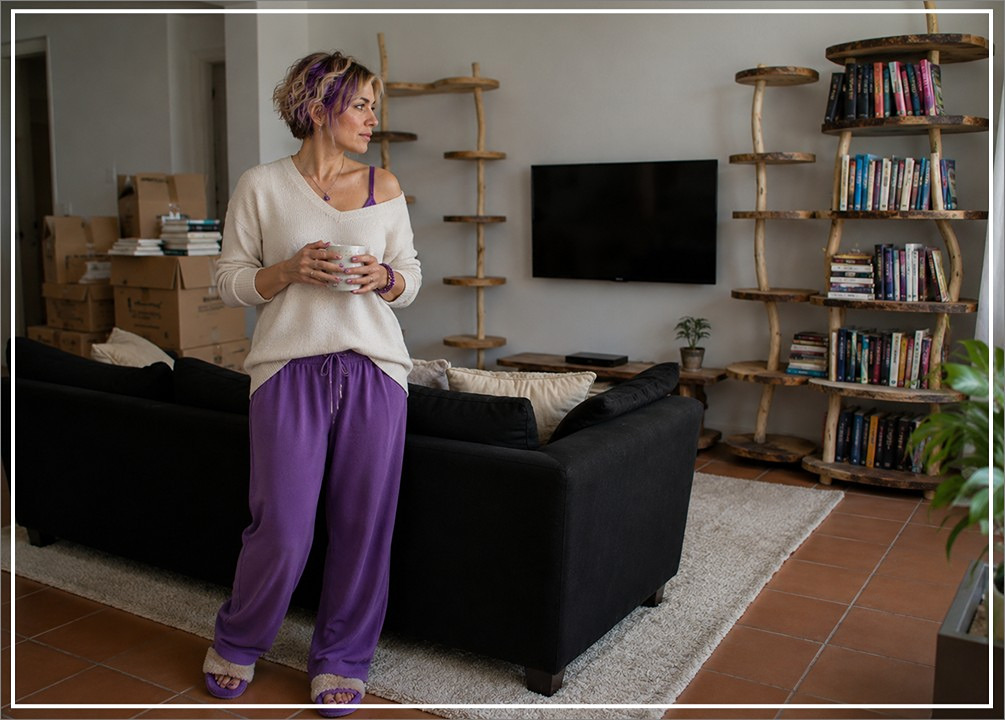
There are still boxes sitting unopened in our apartment in Frankfurt.
Not because we’ve only just arrived. We moved months ago. The boxes that remain are mostly books, the kind of things you don’t urgently need in daily life, the things that belong more to settling than surviving. Recently, my husband finally put up one half of our bookshelves and I filled them almost immediately, relieved to see at least some of our books out in the open again instead of stacked away in cardboard. The other half of the shelves is still sitting unfinished against the wall, not fixed into place, while the remaining boxes stay closed nearby. And honestly, it bothers me.
In previous moves we unpacked much faster. Partly because we had larger apartments where the less urgent boxes could simply disappear into another room for a while, and also because we were actively trying to settle ourselves, and the bunnies, properly into our new home as quickly as possible. Unpacking used to feel connected to building a life somewhere. This time feels different.
We’re now facing another period of uncertainty around work, and with it the possibility that we may need to relocate again, potentially to another country. So, the hesitation around the shelves and the remaining boxes isn’t symbolic or abstract. It’s practical, emotional, and frustrating all at once. There’s a strange feeling of wondering what the point is in fully finishing this process of settling into Frankfurt when another move already feels close enough to shape how we’re living now.
Prefer to watch? You can hear me talk about this below.
Leaving Salzburg was emotionally far harder than I expected it to be. From the outside, the move to Frankfurt probably looked practical enough. Circumstances meant that life simply continued in another country, another city, another apartment. Emotionally, however, it never felt that straightforward.
Salzburg had become deeply woven into my life. It held friendships I genuinely loved, the kind that had grown slowly and steadily over time, friendships that made life feel anchored in a way I hadn’t fully appreciated until I had to leave them behind. Salzburg also held something far heavier. It was the place where we lost our three bunnies. Forrest first. Then Olaf, and finally Bobo, our last bunny, whose passing seemed to close an entire chapter of life all at once. So, by the time we left Austria, I was already emotionally exhausted.
I arrived physically in Frankfurt while part of me still felt firmly attached to Salzburg, to the apartment we had left, to the people there, to the life that had slowly formed around years of living in one place. Moving itself takes energy, however, emotional relocation often happens far more slowly than physical relocation. You can transport your belongings within days while internally still standing in the old kitchen months later. And yet, despite all of that, I had started trying to settle here.
One of the biggest things for me was finally having a proper office space. In Salzburg, my office sat directly beneath the roof, and for much of the year it was difficult to use properly. In summer it became unbearably hot. In winter it was freezing. There were only a handful of months each year where it actually felt comfortable enough to work there full-time. I hadn’t realised how much that affected me until we moved.
For the first time, I’ve had a workspace where I can simply sit down and work without negotiating with the environment around me first. No dragging fans around. No layering blankets over my knees. No constantly shifting where I worked depending on temperature and season. The emotional relief of that landed more deeply than I expected.
And I had just started relaxing into it. Just started allowing Frankfurt to feel a little more stable, a little more permanent, when circumstances changed and another relocation became a very real possibility. The uncertainty was enough for me to realise that our life here might not be as permanent as I had begun allowing myself to believe. I could feel my mind responding to that almost immediately, even before I consciously acknowledged what was happening.
I noticed my thinking changing before I fully admitted why. Don’t rush to unpack everything. Don’t create roots too quickly. Don’t invest too deeply too soon in case you leave again. Don’t build too much emotional attachment to people or places before you know whether they’ll last. None of these thoughts arrived loudly. They came quietly, logically almost, as if my mind had started trying to protect me from the exhaustion of rebuilding everything again. And the strange thing is, I understand why that response is happening. Repeated instability changes you. Not necessarily in obvious ways at first. You still function. You still adapt. You still organise the move, learn the train routes, figure out the supermarkets, sort paperwork, rebuild routines. Outwardly, you look capable and flexible. Many women living abroad become exceptionally good at adaptation because they’ve had to.
Internally, though, something more subtle can start happening. You begin emotionally remaining half packed. You stop fully trusting permanence. You hesitate before allowing yourself to relax into a place because part of you is already calculating what leaving it again might feel like. Even positive things begin carrying a small undercurrent of caution. I can feel that caution now in ways I couldn’t have recognised years ago.
It’s there in the unopened boxes. In the unfinished bookshelves. In the strange reluctance to fully commit emotionally to this version of life because the possibility of another relocation already feels real enough to shape my behaviour before this life in Frankfurt has properly settled. And it creates a kind of tiredness that rest doesn’t really touch. Not burnout exactly. Not even physical exhaustion in the usual sense. More a constant low-level vigilance, as though part of your nervous system never fully stands down because it has learned stability may not last long enough to fully trust it.
That ongoing adjustment wears quietly on you. Every move requires rebuilding practical life from scratch. It also requires rebuilding emotional life from scratch, and that second part often goes unseen. Friendships. Familiarity. Routine. Small places that make life feel yours. The café where you automatically know what to order. The walking route your body recognises without thinking. The sense of belonging somewhere without having to consciously construct it. It can also leave the personal parts of life that can remain postponed while everything feels temporary sitting at the edge of your attention: the project, ambition or piece of work you still intend to return to once life feels more settled.
Repeated relocation interrupts that process over and over again. And eventually, adaptability can slowly become guardedness without you fully noticing the shift happening. You still engage with life. You still function. Though perhaps with a little more emotional caution than before. A little more restraint around attachment. A little more hesitation before fully arriving somewhere internally.
I don’t judge myself for that. I can understand why my mind is trying to create protection after repeated instability. However, understanding it doesn’t completely remove the sadness underneath it either. Because there’s also loss in living this way, in constantly holding part of yourself slightly back from the place you currently are. And that’s often the part women living abroad don’t openly speak about.
From the outside, life abroad can look exciting, expansive, enviable even. There are beautiful moments within it, absolutely. New experiences. Different cultures. A wider sense of the world. I’m grateful for many parts of this life. Alongside that, though, exists another quieter reality, one that rarely photographs well. The repeated rebuilding. The uncertainty underneath practical decisions. The subtle erosion of confidence that can happen when your foundation repeatedly shifts beneath you. The way instability slowly teaches your nervous system not to settle too deeply anywhere.
I’ve noticed lately how much space it helps to have where these patterns can simply be acknowledged honestly without immediately trying to fix them. Sometimes that happens through 1-1 Support & Healing sessions, where women begin untangling what belongs to current circumstances and what has gradually become nervous-system self-protection after years of adaptation and uncertainty.
What I’m slowly recognising is that physically arriving somewhere and emotionally landing there are two very different things. One happens through logistics. The other requires a nervous system that still believes it’s safe to unpack fully. And sometimes, after enough instability, even putting books back onto shelves can begin carrying more emotional weight than you initially realise.


Continue Exploring When Change Has Made It Hard to Settle
Repeated change can leave us preparing for the next disruption before it has even happened, making it difficult to relax fully into where we are now. The Overcoming the Fear of Change Self-Healing Bundle offers gentle, self-guided support for exploring the fears that can build around change and uncertainty.