
the call that both ends and stays with you
Other articles you might also enjoy:
living abroad has changed my idea of home
Whenever I’m travelling, whether it’s just me or my husband and me, I always let my parents know where I am. It doesn’t matter if it’s a weekend away or something longer, I tell them when we’ve arrived, and I tell them when we’re back. It’s just something I’ve always done since moving away from Northern Ireland, a quiet way of making sure they don’t worry if they can’t get hold of me.
Recently, over Easter, we went away for a couple of nights to Stuttgart. When we arrived, I sent my mum the usual message to let her know we’d got there safely, and when we got back to our apartment in Frankfurt, I called her like I always do. It was Easter Sunday evening, and the conversation started the way it usually does, talking about the trip, what we’d done, the small details that fill in the gap between one call and the next.
Then it naturally shifted focus to her and dad. She told me that their heating had stopped working on Friday evening. It’d already been a public holiday, and by the time it broke, it was after normal working hours anyway. There was no one available to come out, and the earliest it could be fixed would be Wednesday, once everything opened up again and everyone went back to work.
She said it was cold. Not in a passing way, not as a complaint, just as a fact. They were cold. She was sitting in the snug with an electric back warmer plugged in, trying to stay warm in whatever way she could. I could picture it clearly, the house, the room, the way she would be sitting, and there was something about hearing it from where I was that made it feel even further away.
I started offering suggestions, the only ones I could come up with from that distance. Go to a hotel for a couple of nights. Sit with the neighbours during the day. Stay with my aunt, my dad’s sister. Go down to my sister’s. Each one felt like a reasonable option as I said it out loud, something that would at least take the edge off the situation until the heating was fixed. However, she said no to every one of them.
Not sharply, not dismissively, just a steady no, one after the other. Even though they were cold, they were at home, and going somewhere else felt worse to her than staying where she was. I kept trying, circling back with different ways of saying the same things, hoping something might land differently. And yet nothing changed. There was nothing I could do.
That was the part that sat there when the call ended. I had all the information, I understood the situation, I’d offered what I could, and still, I was left exactly where I started, on the other end of a phone, too far away to actually change anything.
Prefer to watch? You can hear me talk about this below.
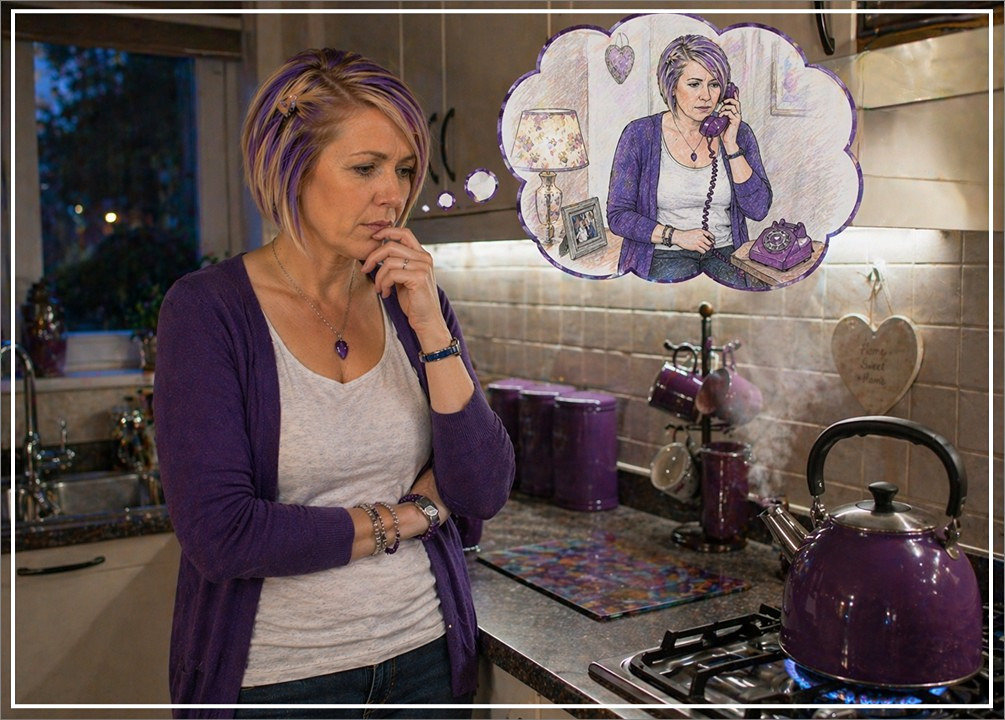
I hung up and carried on with my evening. And at the same time, I didn’t. Because part of me stayed with them, in their house, in the cold, in a situation I couldn’t step into or fix. It’s a strange place to be, where your life continues as normal around you, and yet something else sits quietly underneath it, pulling your attention back to somewhere else.
A day or so later, she messaged to say she had spoken to my sister. My sister, who lives just an hour away, knew a plumber, and within a couple of hours on Easter Monday he’d arrived and fixed the problem. It was sorted quickly once the right person knew about it, simple in a way that made the days of waiting feel unnecessary.
And yet the first person she told was me. Me, in Frankfurt, too far away to do anything practical about it. She hadn’t thought to mention it to my sister until later, even though she was the one who could actually step in and help. It wasn’t something that needed analysing, it was just how it happened. All’s well that ended well.
And still, something stayed with me. Because it’s not always about whether the situation gets resolved in the end. It’s about that space in the middle, the part where you know something isn’t right and there’s nothing you can do from where you are. There’s no urgency, no crisis, nothing dramatic unfolding, and yet it doesn’t sit comfortably either.
If, like me, you too live away from where you were born, a distance away from your parents, you’ll recognise this in your own way. Those moments after a call where something lingers, something you can’t quite put down straight away. You know what’s happening, you understand it, and still there’s a gap between that knowing and being able to act on it.
It isn’t always big things. Sometimes it’s small, everyday situations that carry a weight you didn’t expect, simply because of where you are and where they are. The distance isn’t just physical, it’s in what you can and can’t do, in the limits of how far your presence can reach.
And it doesn’t always show itself clearly. There’s no clear label for it, no obvious moment where you stop and name it. It sits in the background, in the quiet tension of living your life while knowing theirs is moving on in a way you’re not fully part of anymore.
There’s a pull in two directions. One part of you is here, in the life you’ve built, the choices you’ve made, the places you’ve chosen to be. Another part is there, tied to where you came from, to the people who are still living their lives in the place you left. Neither cancels the other out. They just sit alongside each other, sometimes comfortably, sometimes not, and moments like that phone call bring the tension into focus in a way that’s hard to ignore.
It isn’t something that needs to be fixed. Although it is something that needs to be held in a way that doesn’t turn into a quiet pressure on yourself. Because it’s easy to slip into feeling like you should be doing more, even when there isn’t actually anything to do. Recognising that doesn’t remove the feeling. It doesn’t close the distance or change what’s already happened. However, it does create a different way of being with it, one that doesn’t leave you caught in that same loop of helplessness. Because these moments don’t usually come with any kind of warning, they appear in the middle of ordinary conversations, in the space after a call ends, in the quiet realisation that something is happening and you’re not there for it in the way you might want to be.
If you pause for a moment, you’ll probably recognise one of your own.

Continue Exploring When Caring Starts to Feel Like Responsibility
Living away from people you love can make it difficult to recognise the boundary between caring about what happens and feeling responsible for making it better. The Establishing Strong Boundaries Self-Healing Bundle offers gentle, self-guided support for exploring what is yours to carry and what may need to remain outside your control.