
what years of moving countries has taught me
I often say I don’t like change.
I don’t like moving. I don’t like packing up a life, dealing with boxes, finding my way around another unfamiliar place, learning another system, and waiting for the newness to stop feeling so present in everything I do. Even when the move itself is right, or necessary, or makes sense on paper, there’s still a part of me that resists the disruption of it. I like knowing where things are. I like the comfort of routine, the feeling that my body doesn’t have to keep recalculating the basics of daily life.
And yet, after all these years of moving countries, I’ve also had to acknowledge something that doesn’t sit neatly beside that: I’m more adaptable than I often give myself credit for.
That doesn’t mean the moves have been easy. They haven’t. Repeated relocation takes a lot out of you, emotionally and physically. I don’t want to dress that up as growth just because growth has happened alongside it. There’s been exhaustion in it, instability in it, a repeated sense of rebuilding that can wear you down in ways that don’t always show from the outside. Still, inside all of that, I’ve learned things about myself I don’t think I would have learned from a more settled life.
Prefer to watch? You can hear me talk about this below.
One of the clearest things I’ve learned is how closely my body responds to change. Historically, big moves have often triggered my Crohn’s to come out of remission. The stress of relocating, the uncertainty, the practical pressure, the emotional strain of leaving one life and beginning another, my body has often registered all of that before I’ve fully admitted how much I’m feeling. Now, I can feel the shifts. The small internal warnings, the sense that something is starting to move in a direction I need to pay attention to. That awareness has built slowly over time.
It isn’t only around moving countries either. I can sense changes in my body on a daily or weekly basis when I need to, not perfectly, and not in a way that makes me immune from anything, rather with a level of attention I didn’t have years ago. Living with Crohn’s has required that, and repeated change has sharpened it. When your body has reacted to stress enough times, you begin to listen differently.
The move to Frankfurt surprised me because that old pattern didn’t happen in the same way. I kept waiting for my body to respond the way it often had before, for the familiar signs that stress was starting to tip things out of balance. Instead, physically, I felt steadier than expected. I could feel the absence of that flare response as clearly as I’ve felt its presence in previous moves, and that mattered to me because it showed me something had shifted, even if I couldn’t explain exactly why.
That kind of knowing is difficult to describe unless you’ve lived inside a body you’ve had to monitor closely. It’s not about being anxious over every sensation. It’s more about learning the difference between ordinary tiredness and the kind that carries a warning, between discomfort that passes and discomfort that needs attention. Over time, you become familiar with your own internal language, and you begin to trust that your body is often telling you something before your mind has found the words for it.
Moving through different countries has also changed how I relate to medical care. Every health system is different, and each one has its own protocols, assumptions, and ways of doing things. For years, I think I was more inclined to accept what I was told because doctors were the authority in the room and I was the patient. I still respect medical knowledge, of course I do, however I’ve also learned that living in my body gives me information that matters too.
My regular infusions made that very clear. In Switzerland and Salzburg, the protocol was to administer the infusion slowly over two or three hours. That was how it was done there, and I accepted it, although I would get side effects afterwards. They weren’t awful, just unpleasant enough to notice, and over time I began to connect them with the pace of the infusion rather than assuming they were unavoidable.
In Amsterdam and Frankfurt, the same infusion was given much faster. In Amsterdam it took around an hour. In Frankfurt it takes about forty minutes. And with that shorter infusion time, I feel much better, with significantly fewer side effects or none at all. Most people don’t get the chance to discover something like that because they stay within one system, one protocol, one way of doing things, and they may never know their body could respond differently under different circumstances.
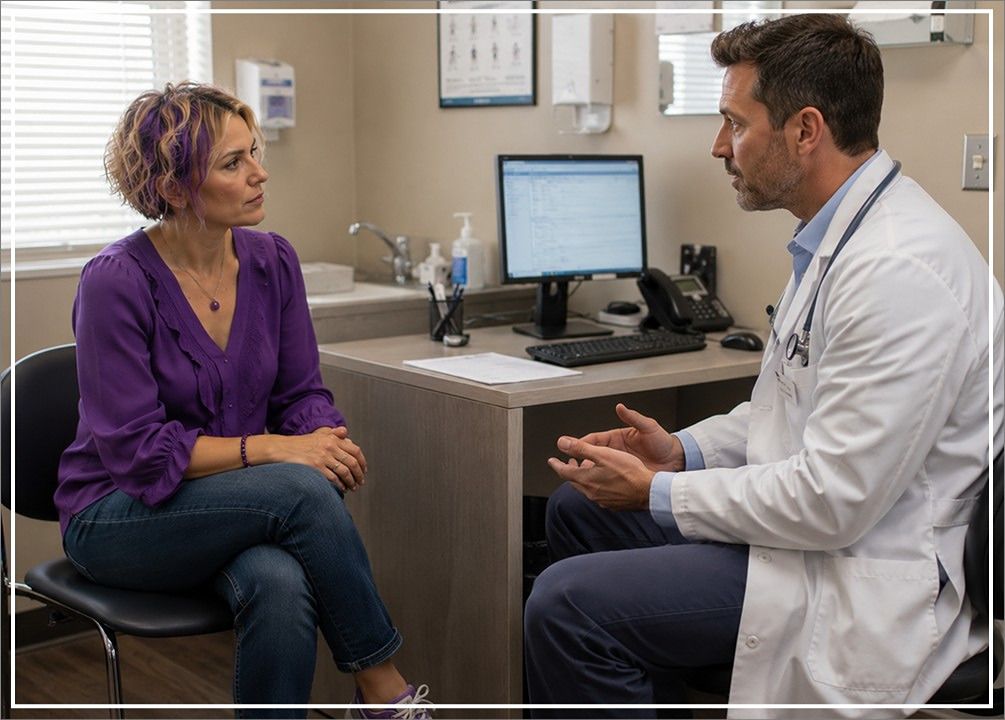
Over time, my relationship with medical conversations started changing. It’s shown me that what is standard in one place is not necessarily the only way. It’s shown me that my experience matters enough to bring into the conversation. And gradually, through having to navigate different health systems, different doctors, different languages, and different ways of being treated, I’ve become more confident in telling doctors what my body needs rather than automatically waiting for them to tell me.
My confidence built slowly. It came through repetition, through sitting in different medical rooms, noticing patterns, and realising that I knew things about my own body that were worth saying out loud. I still don’t find it easy every time. There’s still a part of me that can feel small in the face of medical authority, especially in another country, in another system. However, there’s also a quieter certainty now, one that knows I have evidence from my own lived experience, and that evidence belongs in the room too.
Life abroad has changed me in quieter ways too. It hasn’t only made me more aware of other cultures or more familiar with different places. It’s made me more attentive to myself. More aware of what I need. More able to notice what supports me and what doesn’t. That kind of self-awareness has come at a cost, and yet it’s still real. One of those costs can be what repeated adaptation quietly asks us to put aside while we deal with the practical work of rebuilding: our own projects, ambitions and unfinished parts of life.
And it isn’t only my health where I’ve seen this. Every move has shown me something about how I rebuild. I may say I don’t like change, and that remains true, however I’ve also seen how quickly I can begin functioning in a new environment once the first shock has passed. I work out what I need first. I find the practical rhythm. I return to my work, because work gives me structure, and structure helps me find myself again when everything else feels unfamiliar.
Being introverted probably helps in some ways too. I don’t need to build a full social life immediately to feel as if I can exist somewhere. I don’t need a large group of people around me straight away. When I move, I tend to reconnect to my work and my own routine first, and then, when I feel ready, I start making connections. That has become my pattern, and recognising it has helped me stop judging myself for not settling in the same way someone else might.
Starting again can carry a surprising amount of pressure. Pressure to explore, to meet people, to make the most of where you are, to be grateful for the opportunity, to create a full life quickly. Some of that pressure comes from other people, and some of it comes from the image you think you’re supposed to live up to when you’re abroad. A life abroad can look exciting from the outside, so there can be very little room for the quieter truth that sometimes, at first, you simply need to find your footing.
I’ve learned that I don’t begin with people. I begin with rhythm. I begin with work, food, walking routes, medical appointments, knowing where the shops are, finding places where my body feels safe, creating enough familiarity that my nervous system doesn’t feel as if every small thing requires effort. Social connection matters, and I know that, however it usually comes later for me. I need to feel myself in a place before I can fully reach outwards into it.
I didn’t have that level of self-awareness when I first moved abroad. Back then, I think I expected myself to adjust more quickly, to settle in naturally, to make a place feel like home because I’d chosen to be there. Now I understand that adjustment has layers. My body may arrive first, then my routines, then my confidence, then my willingness to connect. Sometimes those layers move quickly. Sometimes they take months. Over time, I also began noticing something else. It wasn't only adapting to new countries that asked something of me. Some of the parts of my own life that mattered most had quietly remained waiting while everything else took priority.
Repeated moving has shown me the difference between disliking change and being unable to handle it. I don’t enjoy the disruption. I don’t enjoy the uncertainty. I don’t enjoy the physical and emotional energy it takes to dismantle one version of life and begin another. And still, I can do it. I’ve done it many times. That doesn’t erase the difficulty, however it does give me a more honest sense of my own capacity.
Recognising that has helped me trust myself differently. Not because it turns instability into something easy, and not because I’d choose constant change for the sake of proving I can handle it. It simply means I know myself differently now. I know that I can be tired and still capable, feel unsettled and still rebuild rhythm. I know that my body needs listening to, and that my preferences around adaptation are not weaknesses.
This is the kind of thing that often comes up in 1-1 Personal Support sessions. Not as a neat conclusion, rather as a lived contradiction women bring with them when they’ve spent years adapting. You may feel exhausted by change and also recognise how much you’ve learned through it. You may feel less rooted than you once did and yet more aware of yourself than you ever were before. Holding both of those truths can take space, especially when the outside world only sees the interesting life and not the constant inner recalibration that comes with it.
The Start Monday with Gratitude year-long experience sits in a similar place for me. It gives me a steady practice of noticing what’s present even while life keeps shifting. When you’ve moved often, it can be easy to focus only on what has to be rebuilt, what has been lost, what feels uncertain. A regular rhythm of noticing can become a kind of anchor, because it helps you register the parts of life that are still supporting you while everything else is moving.
That matters more than it might sound. Because repeated change can make you feel as if nothing holds. And yet there are often small forms of steadiness that do remain, even if they aren’t the ones you expected. Your own rhythm. Your body’s signals. The work you return to. The way you learn what helps you settle. The quiet evidence that you’ve adapted before.
I still don’t like change. I still don’t like moving. I still don’t enjoy the uncertainty of not knowing where life will take us next, or the practical and emotional labour involved in starting again. I don’t need to pretend otherwise in order to recognise what these years have given me. They’ve given me a closer relationship with my body and a stronger voice in medical spaces. They’ve shown me that I rebuild from rhythm first, connection later, and that my capacity is greater than my initial resistance to change would suggest.
And perhaps that’s the clearest way I can understand it now. Repeated moving has taken a lot from me in energy, certainty, and rootedness. However, it’s also returned me to myself in ways I may never have found if life had stayed still.