
small chaos does not stay small
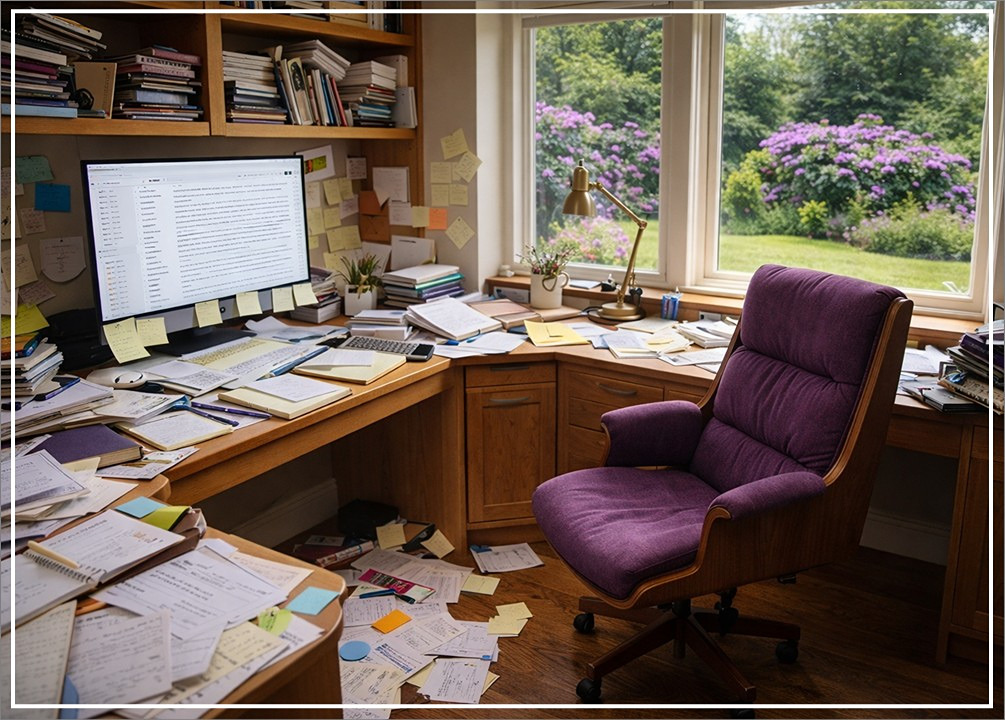
I open the door to my dad’s office and the first thing I notice is the paper.
Not one neat pile, not one active file, rather small bundles on every available surface. Envelopes slit open and left half-folded. Bank statements spread across the desk as though in mid-reconciliation. A notebook open to a page of thoughts that stop halfway down, the pen resting diagonally across it as if he has just stepped out for a moment and will return to finish his notes.
There is a chair opposite his desk, the seat of it being the only empty surface in the room. When we talk, he begins in one place and then veers into another. A question about my life becomes a memory about his work which becomes a question about something entirely unrelated. Threads are picked up and then put down again. Sometimes they hang loose, never returned to.
The room holds activity without completion. Movement without containment.
It is easy to focus on the visible disorder, the spread of paper, the unfinished writing. Harder, perhaps, to name the quieter pattern underneath it. The way conversations lose direction. The way small tasks seem to fragment into smaller ones. The way nothing feels entirely concluded.
The office is not chaotic in an explosive way. It is simply uncontained.
Most of us have a version of that office somewhere in our lives.
It may not look like paperwork. It may look like browser tabs open across multiple devices. Half-written emails sitting in drafts. Projects begun with enthusiasm and then left hovering in a corner of your mind. Commitments made without a clear container to hold them. Conversations you intend to have. Decisions you intend to make. Systems you intend to set up.
Nothing is entirely broken. And yet, nothing is entirely clear either.
There are small gaps everywhere.
Where are things slightly untidy for you? Slightly uncontained? Slightly disorganised in a way that feels manageable enough to ignore?
Perhaps it’s your calendar, full yet oddly reactive. Perhaps it’s your finances, functional yet not fully understood. Perhaps it’s your emotional life, where certain topics are quietly avoided and certain boundaries remain implied rather than stated.
It doesn’t need to be huge or dramatic to be unstable. It only needs to be loose.
I understand structure.
My early career in finance trained me to think in columns, reconciliations, audit trails. It was a world where balance sheets had to balance. Where there was a rhythm to month-ends, quarter-end, year-ends that needed to be adhered to. The environment was rigid, often, if felt, excessively so, and somewhere where I never felt I belonged. When I left that world, I rejected more than the job. I rejected the structure itself. Because I never felt I belonged, I fitted in, I was part of that world.
Spreadsheets became symbolic of restriction. Process felt like confinement. I told myself I wanted freedom, creativity, space to move. And I created it. No fixed working hours. No defined rhythm to my week. Decisions made instinctively. Offers built on the fly. Administration done when it became unavoidable.
For a while, that felt expansive.
Over time, however, it began to feel and be expensive.
Not financially at first, though that came later. Energetically. Mentally. The constant micro-decisions. The repeated re-orienting. The subtle anxiety of not quite knowing what was solid and what was provisional. When everything is flexible, nothing fully holds.
I became reactive without intending to be. Emails dictated my day. Client needs shaped my schedule. Inspiration determined my output. There was a certain pride in being able to “fly by the seat of my pants”, to respond quickly, to build as I went.
However, flying without instrumentation requires constant correction.
What I slowly recognised was that lack of rhythm leaks energy. It creates invisible instability. When there is no conscious structure, unconscious structure forms. It forms around urgency, around avoidance, around whatever shouts loudest in the moment.
In contrast, structure, when chosen rather than imposed, does not confine. It stabilises.
Introducing rhythm back into my work was not a return to corporate rigidity. It was a deliberate decision to create containers. Defined work blocks. Clear financial tracking. Set review points. Boundaries around availability. The shift was subtle at first. There was resistance. A part of me associated structure with loss of freedom. In practice, however, it created steadiness.
A little chaos in ordinary conditions is manageable. You can compensate. You can work around it. You can hold the loose threads in your head. If a few things are slightly disorganised, you absorb the cost through extra effort.
Under acceleration, however, chaos compounds. Speed does not create instability. It multiplies what is already loose.
When pace increases, small inefficiencies widen. A slightly unclear offer becomes a confusing one. A vaguely defined boundary becomes a source of resentment. An imprecise financial system becomes a cash flow problem. An unresolved tension becomes a fracture.
Acceleration removes the buffer that previously hid the weakness.
Unfinished threads begin to tangle because there is less time to track them. Minor gaps in communication become consequential misunderstandings. Decisions made casually at low speed become expensive when momentum builds around them.
If your calendar is already reactive, an increase in demand does not simply make you busier. It makes you fragmented. If your finances are loosely monitored, increased revenue does not automatically create stability. It can amplify misalignment. If your emotional boundaries are porous, greater visibility or responsibility does not strengthen them. It stretches them further.
Momentum magnifies structure… or the lack of it.
In my dad’s office, the paper does not rearrange itself when more arrives. It simply stacks higher. Conversations do not become clearer when interrupted more frequently. They splinter faster.
Acceleration is impartial. It does not discriminate between well-built systems and loosely held ones. It amplifies both.
This is where the metaphor stops being comfortable.
We have very recently entered a Fire Horse year.
The Fire Horse does not tiptoe into an already imperfect structure. It accelerates within it meaning that what is loosely held will not remain loosely held, and what is slightly unstable will not stay slightly unstable.
Acceleration does not negotiate.
What is loose will tighten… or tear.