you don’t need more advice
Picture this scenario.
You've a decision to make. However, you’re not sure what that decision should be. So, you ask someone you trust. Sounds simple enough, right?
You message a family member, explain the situation, and wait for their response, hoping they’ll say something that makes it clearer for you. They reply, they share what they would do, and for a moment it feels like you’ve got something to hold onto, something that might help you move forward.
Then you think it’d be useful to get another perspective; two minds are greater than one, right?
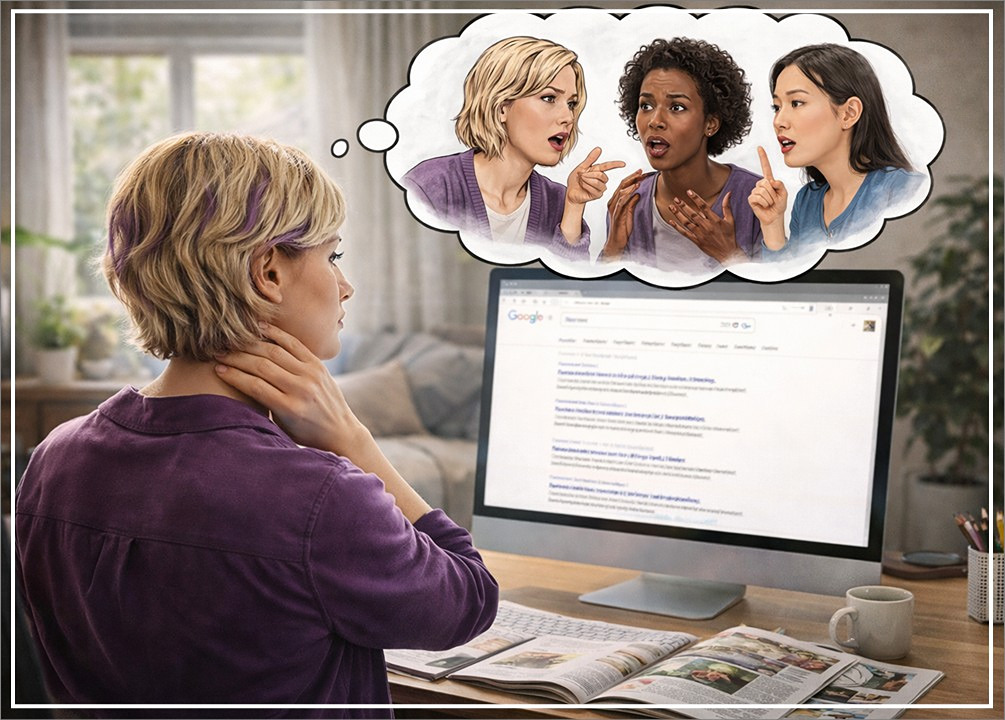
So, you ask someone else, maybe a friend who sees things differently, just to balance it out, just to make sure you’re not missing anything. Their answer comes back, and it doesn’t quite match the first one, not completely, not in a way that lines up neatly, and now you’re holding two different suggestions instead of one.
It doesn’t stop there, however. You decide to Google about it, read a few articles, scroll through different opinions, each one sounding convincing in its own way, each one adding something new to consider. You might watch a couple of videos, listen to someone explain it in a way that almost clicks, then watch another that pulls you in another slightly different direction again. If you use oracle cards, a pendulum, or another kind of guidance, you might turn to them also.
The first response you received gives you something to work on, the second time adds to it, and by the third you’re trying to make sense of how they all fit together. Each one feels relevant, each one feels like it could be pointing you somewhere, and yet none of them land in the same place.
What you’re left with isn’t clarity. It’s more information, more angles, more things to think about, and somehow less certainty than when you started. Instead of moving closer to a decision, you’re now holding multiple versions of what that decision could be, each one backed by something that makes it seem valid.
This is where the pattern settles in. You go back over it again, replaying what each person said, reconsidering the points that stood out, weighing them against each other as if the right answer will magically reveal itself if you think about it long enough. You move between options, leaning one way, then pulling back, then leaning another way, without actually stepping into any of them.
It starts to feel like you’re stuck. Like you just can’t decide, like something isn’t clear enough yet, like you’re waiting for the moment where it all clicks into place and the answer becomes obvious. And because it doesn’t, you stay where you are, still thinking, still checking, still looking for something that settles it.
You’re not stuck, however. You’re not deciding. There’s a difference between not having enough information and not choosing, and most of the time, you’ve already gathered more than enough to move forward. What’s missing isn’t another opinion or another piece of guidance, it’s the moment where you commit to one direction and follow it.
That’s where something else sits underneath all of this: not trusting yourself to make the decision, not fully backing what you already know, and instead looking outside of yourself for something that feels more certain. It can look like being thorough, like doing your due diligence, and yet at its core it keeps you from having to take responsibility for the outcome of the choice you need to make.
The more input you bring in, the harder it becomes. Because now it isn’t just your own thoughts you’re navigating, it’s everyone else’s as well, layered on top of each other, pulling you in different directions. More input doesn’t create clarity at that point, it creates noise. And the more noise there is, the easier it is to stay where you are.
This is something I see again and again. Clients and students come into a conversation already holding multiple opinions, already having gone through different perspectives, already having tried to work it out from every angle they can access. They’re not lacking information, they’re overwhelmed by it, and somewhere in the middle of that, their own sense of what feels right has been pushed to the side.
What I notice is how quickly things can shift when that noise is removed. When the situation is looked at cleanly, without all the extra layers, without trying to hold every perspective at once, what’s actually going on becomes much clearer. Not because something new has been added, rather because what’s already there can finally be seen without distortion.
I see what you can’t see when you’re inside it. I can step outside what you’re caught in and look at it without the same attachment, without the same looping, without the need to make all the different inputs fit together. That creates a kind of clarity that isn’t available when you’re in the middle of it, trying to think your way through it.
That’s my superpower.
Not in some ostentatious way, not as something separate or special, just in the way I can cut through what’s built up and bring it back to what actually matters. It doesn’t take long, and it doesn’t require more information, it just requires looking at it from the outside rather than staying inside the loop. Because the longer you stay in that loop, the more time passes without anything changing.
You can spend days, weeks, sometimes much longer going over the same decision, checking, rechecking, revisiting, and all of that time is spent in movement that doesn’t actually move anything forward. It builds a sense of effort without creating a result, and that can be hard to see while you’re inside it.
If you want something different, it doesn’t come from asking more people. It comes from stepping into a space where the noise is removed and the situation is seen clearly for what it is. That’s where something like my 1:1 support & healing sessions fit beautifully, not as another opinion to add to the pile, rather as a way of cutting through everything that’s already there and getting to the point quickly.
Because staying in the loop will always feel like you’re doing something. You’re thinking, you’re checking, you’re engaging with it, and yet the decision itself remains untouched, sitting there waiting for you to actually choose. Until that happens, nothing shifts, no matter how much time you spend going over it.
At some point, you need to stop asking… you need to decide.