
you're more sensitive than you think
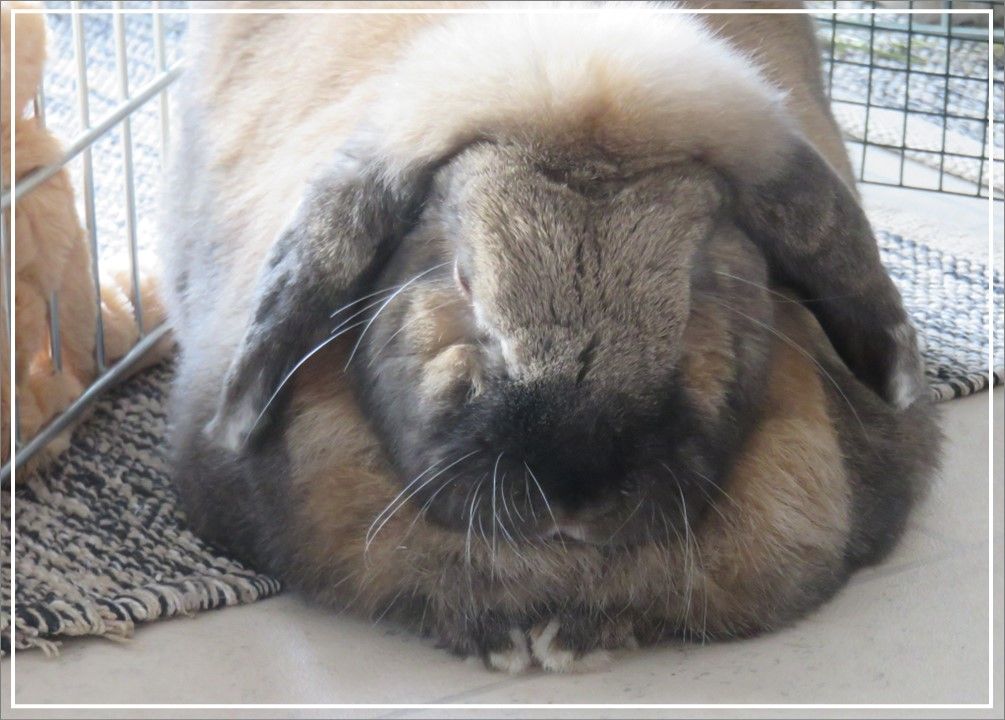
We can learn a lot from the animals we share our lives with, although perhaps not always in the way we initially think. These past few months, I've found myself watching my beloved bunny, Bobo, particularly closely. His best friend and partner, Forrest, passed after a short illness, and in the period around her death and afterwards, his familiar little world changed considerably. Watching him through that time made me think about grief, change and sensitivity, not because I believe I can know exactly what was happening inside him, rather because it made me realise how readily I can underestimate what might be happening inside me.
Bobo couldn't tell me what he was feeling. I could observe him, notice changes in his behaviour and make my own interpretations. Ultimately, though, they remained interpretations.
There was one moment around Forrest's passing that has stayed with me. Bobo is normally such a gentle bunny, however as Forrest approached the end of her life, he went into his litter tray and started behaving in a way we'd never seen before. He was banging his feet and throwing hay around, almost as though he was having a temper tantrum. To me, he looked distressed, angry perhaps, hurting, and I remember watching him and thinking that he knew something was changing with Forrest, that somehow he was responding to what was happening around him. Could I know that for certain? No. However, I knew my bunny, and I knew this wasn't how he normally behaved.
Around that period, Bobo also experienced gastrointestinal stasis. Stasis can be very serious in rabbits, so when he became unwell we responded quickly and involved veterinary care. Thankfully, on that occasion, he recovered and was soon back to his usual self, running around and searching for treats. A couple of weeks later, though, it happened again, and over the following period there were several more episodes, including one frightening occasion when he became so unwell that I genuinely thought we might lose him.
It's truly horrible watching an animal you love become ill when they can't tell you what hurts or what they need. You're watching constantly, trying to notice every tiny change, hoping you've understood correctly and wondering what else you might be missing.
All of this was happening during a period when so much else had changed for Bobo too. After Forrest passed, we adopted another bunny, Olaf. We hoped, of course, that Bobo would find companionship again, however the new relationship didn't develop as easily as his relationship with Forrest had. He and Forrest had bonded quickly, whereas this new dynamic was different and took considerably more navigating.
At times, I wondered whether Bobo was struggling with that too. Perhaps he was unsettled by the change. Perhaps I was interpreting his behaviour through my own worry about him. I couldn't know precisely what either bunny was experiencing emotionally. What I could see was that Bobo's familiar world had altered significantly within a relatively short space of time. He had lost Forrest, another bunny had arrived, their relationship was different, and alongside all of that, he was experiencing these worrying episodes of stasis.
During one particularly serious episode, our vet also discovered an issue with Bobo's liver readings. At the time, because I was already thinking so much about grief and emotional stress, I found myself wanting to connect all these things together. I wanted to understand what was happening to him and why. The fact that difficult emotional circumstances and physical illness occur during the same period, though, doesn't tell me that one caused the other. I don't know if Bobo's grief caused his stasis, I don't know if the changed relationship with his new companion caused it, and I can't say if his emotions caused the issue found in his liver readings. Those were things happening during the same difficult period of his life, and his physical health needed the veterinary attention it received.
What watching him did do was bring my attention back to something I already believe: that we are sensitive beings on more than one level, and that emotional experiences can touch us emotionally, energetically and physically, sometimes more deeply than we consciously realise at the time.
Perhaps Sensitivity Isn't What I Thought it Was
I've sometimes imagined sensitivity as something visible. If something has affected us deeply, surely we know. We're devastated. We're crying. We're unable to concentrate. We can point at ourselves and say, Yes, clearly I'm struggling with this. And yet, human beings have a remarkable ability to keep going while carrying something difficult. We get up, we work, we answer messages, we make dinner, we talk to people and we do whatever needs doing that day, and because we're functioning reasonably well, we can assume we're also emotionally fine. Sometimes we genuinely are fine.
And sometimes something small happens and we suddenly realise there's far more sitting underneath the surface than we had appreciated. A comment catches us unexpectedly, something reminds us of somebody, we become emotional over something that would normally barely register, or we find ourselves unusually tired of dealing with people or less able to brush off something we'd normally take in our stride.
Sometimes these moments simply make us stop and think: Actually, this has affected me.
That feels very different to me from saying we're fragile. We can be capable and deeply affected by something. We can be resilient and grieving. We can cope with enormous change and still find parts of it difficult. We can carry on with ordinary life while something much less ordinary is sitting quietly beneath it. Those things can exist together.
And, within my own understanding of healing and wellbeing, I don't believe our emotional, energetic and physical selves exist in separate compartments. They are interconnected parts of our whole self. Sometimes I believe one part of us can be drawing our attention towards strain, emotion or an experience that our conscious mind hasn't fully acknowledged yet, not necessarily because there is something to fix, but because perhaps there is something asking to be noticed.
Grief Doesn't Have a Timetable
Watching Bobo after Forrest passed also reminded me how much I dislike the idea that grief is something we should know how to do ‘properly’. There was no magic wand I could wave over Bobo and make Forrest's absence disappear. And there isn't one for us either. When somebody or something we love is gone, we respond in our own way and in our own time.
There may be days when the loss feels enormous and days when life feels surprisingly normal. Something we thought we'd adjusted to may suddenly hurt again months later. We may want to talk about the person we've lost constantly, or find that we don't want to talk about them at all. None of that needs to become another standard against which we judge ourselves.
I don't think grief requires us to uncover every emotion, release it correctly and emerge successfully ‘healed’ at the end. Sometimes perhaps what we need most is simply to recognise that we're grieving and allow that to be true without immediately deciding what we should do about it.
And grief isn't the only experience we can underestimate. Uncertainty can affect us. Change can affect us. Worry about somebody we love can occupy far more of our emotional and energetic attention than is visible from the outside, and this can become particularly strange when we're living in another country. We might be getting on with our life abroad while somebody we love back home is ill or growing older, perhaps waiting for updates from family, wondering whether we should travel or feeling guilty that we aren't there, even when being physically present might not change anything. Or perhaps somebody has died and we're grieving at a distance from the family, people or familiar places we would normally associate with that loss.
That doesn't describe everybody's experience of living abroad, of course, however distance can sometimes add another layer to something already emotionally difficult. From the outside, we can look perfectly capable. We go shopping, meet somebody for coffee, work and make plans for the weekend, and yet part of us is somewhere else entirely. Perhaps that is why I'm becoming more interested in what we carry beneath the surface of ordinary life, particularly when we ourselves haven't quite acknowledged how heavy it has become.
We Don't Have to Turn Every Feeling into a Problem
I think there's a temptation, particularly when we're interested in healing and inner growth, to assume that noticing an emotion means we immediately need to do something with it, whether that's processing it, releasing it, healing it, finding its origin, understanding its lesson or exploring what we're feeling more deeply.
Sometimes, though, I think we can simply notice: I'm more upset about this than I realised. I'm still grieving. I'm worried. That change has unsettled me. I thought I was okay with what happened, but perhaps I'm not as okay as I thought.
There doesn't have to be judgement attached to that recognition, and there doesn't have to be an immediate solution either.
For me, paying attention to my whole self is part of that awareness. I believe my emotional, energetic and physical selves are deeply interconnected, and that what I experience in one part of myself can sometimes be felt elsewhere too. There have been times when my body or energy has made me stop and pay attention to something I hadn't fully acknowledged emotionally, and I value that relationship with myself rather than automatically dismissing it.
That doesn't mean I need to assign an emotional meaning to every physical sensation or assume that every illness contains an emotional message. If something new, persistent or concerning is happening physically, it deserves appropriate professional medical attention.
But alongside that, I can still listen to myself as a whole person.
I can ask whether I've been carrying more than I realised, whether something has affected me more deeply than I initially acknowledged or whether I simply need more gentleness around whatever I'm experiencing.
And none of that makes grief, struggling or illness a failure. There is no spiritual standard we have to meet in which difficult emotions must be identified and released quickly enough to prove we're healing correctly. Sometimes putting on a brave face is simply how we get through a particular day, and sometimes it takes considerably longer before we realise just how much that day, or week, or season of our life has asked of us.
What if it Affected You More Than You Realised?
This, more than anything, is what Bobo's experience left me thinking about. Not whether I could correctly identify every emotion he might have been experiencing, and not whether I could find one neat explanation connecting everything that happened to him, rather how easily I assume that because somebody, including me, is continuing to function, whatever happened must not have affected them too deeply.
I'm not so sure anymore.
Sensitivity may be much quieter than that. It may sit alongside competence and resilience rather than being their opposite, and acknowledging our sensitivity doesn't require us to collapse beneath whatever we're carrying. It can simply mean allowing ourselves to admit that something mattered, that something touched us emotionally or energetically, that beneath everything we're continuing to do there may be another part of us asking for some attention.
Sometimes having somewhere to explore that recognition can help us understand it a little better too. Personal Support can offer space to talk about an experience that has affected you more deeply than you expected, particularly when you've been carrying it alone or aren't entirely sure what you're feeling, without requiring you to turn that experience into something that needs to be immediately fixed.
Because perhaps we don't always need fixing. Sometimes we need time or support or simply to let grief be grief and uncertainty be uncertainty without rushing to transform either of them into a lesson. And sometimes we may simply need to stop insisting that because we're getting through the day, we must therefore be completely fine.
Watching Bobo during those months brought me back to my belief that emotional experiences can touch us on more than one level, and that we're sometimes more sensitive to what life brings us than we consciously recognise. His world had changed enormously in a short period of time, and while I could never know exactly what he felt about those changes, watching him made me pay closer attention to how I respond to change, loss and emotional strain in my own life.
I used to associate sensitivity much more readily with being overwhelmed or unable to cope. Now I see more room within it. We can carry on and be capable. We can laugh, work, make dinner, answer messages and do everything that needs doing, while something deeper within us has still been affected.
For me, recognising that means paying attention to my whole self rather than using my ability to function as evidence that everything beneath the surface must be fine. I don't need to diagnose every feeling or search every ache or illness for an emotional meaning, but neither do I want to dismiss what I'm carrying emotionally or energetically simply because I'm still getting through the day.
Perhaps we're more sensitive than we think - emotionally, energetically and in the ways our whole being responds to what life brings us.
Recognising that sensitivity isn't weakness.
Perhaps it's simply another way of listening to ourselves.

Continue Exploring After an Emotional Setback
If something has affected you more deeply than you initially realised, this oracle card reading offers gentle guidance and reflection around what you may need emotionally as you find your own way through the experience.
Viv xx